A structured alert service
Rules-based options setups delivered to Telegram with ticker, direction, contract details, entry context, and supporting chart information.
What the service is, how alerts are documented, what the public record shows, what you control, and what Blue Chip Signals does not claim.
Blue Chip Signals identifies options setups on 6 liquid large-cap names and publishes a consistent alert format. It does not know your finances, choose your size, place trades, or manage positions for you.
Rules-based options setups delivered to Telegram with ticker, direction, contract details, entry context, and supporting chart information.
No alert is personalized. Blue Chip Signals never holds member funds, connects to member brokerages, or guarantees a trading outcome.
Membership determines which ticker channels are available.
Evaluate the setup, contract, chart, and risk in real time.
Choose whether to act, how much to risk, and when to exit.
The alert is the product. Each one uses a repeatable information hierarchy so a self-directed trader can inspect the setup quickly without decoding commentary.
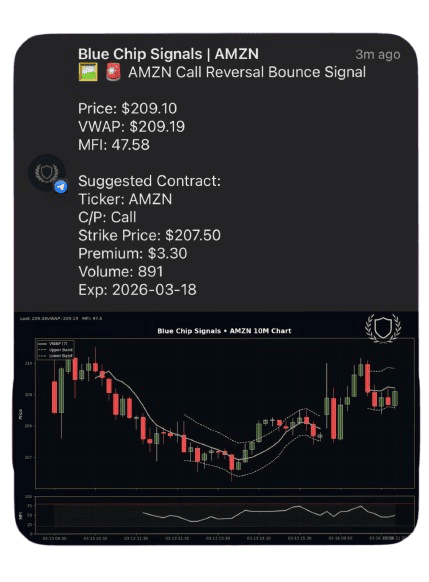
Every published performance surface needs a clear basis. The public track record and the modeled replay answer different questions and remain labeled as different evidence.
The public track record lists closed signals, including wins, losses, and stop-outs. It measures the published alert record from market data. Open positions remain excluded until they close.
The Risk Simulator applies stated sizing and exit assumptions to resolved signals. It is not a real account, not a measured fill, and not a guarantee of future performance.
Review the cumulative record and methodology on the Track Record page.
Outcome definitions, modeled assumptions, fill limitations, and past-performance language are published with the figures.
A demo can show the alert format, channel structure, strategy framework, and member workflow directly.
Questions can be addressed directly with the person who built and operates the service.
Published alert prices do not prove that every member received or executed the same fill. Timing, liquidity, slippage, and member decisions vary.
No service can eliminate trading risk. Blue Chip Signals does not guarantee profits or represent alerts as personalized financial advice.
Blue Chip Signals is founder-led. Strategy development, product decisions, and platform engineering trace back to one operator instead of an anonymous publishing team.

Founder and Architect
Hamza built Blue Chip Signals after learning firsthand that discretionary options trading without a repeatable process can become expensive. The service began as a system he built for his own time constraints, then rebuilt for self-directed traders who needed a clearer workflow.
The public commitment is simple: show the alert format, document the process, publish the limitations, and never manufacture trust through fake reviews or unsupported claims.
Hamza was seventeen when a high school history teacher ran a week-long paper trading competition. Most of the class treated it like a free period. Hamza studied tickers between classes, checked prices at lunch, and placed sixth.
By the weekend, every other student had moved on. Hamza opened a real brokerage account and started reading everything he could find about how markets move. Within a year, he discovered options trading. Within two, he had lost more than $20,000.
The losses were gradual. His long-term portfolio underperformed. His short-term plays were reckless. The problem was trying to trade like someone with eight free hours a day while splitting every waking minute between college and a job.
He dropped out, not to trade full time, but to build something that could monitor the market the way he would if he never had to look away from the screen.
He taught himself to code from documentation, trial and error, and repetition. Two years later, the first version of what became Blue Chip Signals was running. It was built to answer one question: how do you maintain a repeatable process when you cannot watch every move?
The first version was for him. Friends and family saw the signals and pushed him to make it usable for people who did not understand every variable under the hood. He spent the next several years rebuilding the system around clearer alerts, defined workflows, and the needs of traders with real capital and limited time.
Every signal, feature, and line of code traces back to that process. The result is a founder-led service with one person accountable for how it works and how it is represented.
Refunds are evaluated case by case. Technical delivery failures and billing errors are different from dissatisfaction with alert frequency, direction, or trading outcomes.
Verified backend delivery failures, extended service outages, channel access failures caused by Blue Chip Signals, or billing errors. Each request is reviewed individually.
Disagreement with a trade direction, dissatisfaction with alert frequency, losses on positions you chose to enter, or a change of mind after receiving access.
The service supplies information. You decide whether an alert is suitable, how much capital to risk, how to execute, and when to exit.
Options trading involves substantial risk and is not appropriate for all investors. You can lose some or all of your invested capital on any individual trade. Past performance of any alert, whether shared or implied, is not an indicator or guarantee of future results.
Blue Chip Signals provides algorithmic trade alert ideas for informational and educational purposes only. Alerts are not personalized investment advice and should not be treated as instructions to trade. Every alert represents a trade idea, not a directive.
You are solely responsible for evaluating each alert, determining its suitability for your financial situation and risk tolerance, and managing your own positions. Blue Chip Signals has no knowledge of your financial circumstances, objectives, or risk capacity.
Do not trade with capital you cannot afford to lose. Do not treat any signal service as a substitute for independent due diligence and professional financial guidance.
Blue Chip Signals operates from the United States. The service is not intended for residents of jurisdictions where options trading or trade alert services are restricted or prohibited. Users are responsible for complying with applicable local laws.
No urgency tactics. Use the public evidence, download the diligence brief, or book a direct walkthrough with the founder.